Local BLE bridge for LLMs and hardware integration
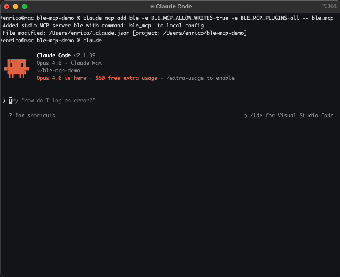
ble-mcp-server, by Es617, is a stateful Model Context Protocol server that gives LLMs access to local Bluetooth Low Energy hardware. It lets agents scan for peripherals, discover services and characteristics, read and write characteristic values, and subscribe to sensor notifications using natural-language commands routed through an MCP client. The server accepts markdown 'specs' to explain proprietary protocols, uses the Bleak library, and runs on Windows, macOS, and Linux. Developers and hardware engineers building agentic workflows use it to avoid per-device integration code and enable direct device control from agent runtimes.
What tasks can you actually use it for?
The server connects language models to BLE peripherals and supports core device interactions. Out of the box it handles:
- scanning nearby BLE devices
- discovering services and characteristics
- reading and writing characteristic values
- subscribing to notifications
How precise is its protocol understanding when specs are provided?
The server uses markdown 'specs' to teach an agent how to interpret proprietary services and characteristic payloads. When a spec is present, agents can map raw bytes to documented fields and produce protocol-aware actions. When no spec exists, the agent still performs discovery and raw reads, but it cannot attach semantic meanings to values without additional documentation, so authoring specs matters for deep automation.
Does it require technical knowledge to get useful results?
The implementation is Python-based and expects an MCP-compatible client to accept agent connections, so it targets developers, hardware engineers, and researchers building agentic workflows. Zero-configuration discovery reduces manual pairing steps, but integrating complex devices and producing reliable agent behaviour depends on understanding MCP runtimes and BLE concepts. Running and validating the server inside a development environment requires developer time and familiarity with local hardware tooling.
How well does it fit into cross-platform developer workflows?
The server uses the Bleak Bluetooth library to provide consistent behaviour across Windows, macOS, and Linux and integrates with MCP-compliant runtimes such as Claude Code, VS Code with Copilot, and the Claude Desktop app. As a stateful MCP server it centralizes hardware access so development teams can route agent commands through a single endpoint rather than writing bespoke glue code per device, fitting into local testing and debugging workflows.
Suited to technical teams that need controlled local device access
This server matches development teams and researchers who accept a technical setup and ongoing integration work in exchange for controllable, local agent access to peripherals. Expect to allocate developer time for integration, validation, and maintenance before relying on it in production. Choose it when predictable agent-driven hardware interactions are a core project requirement rather than consumer simplicity.